Bennett Acceptance Ratio Method and Error Estimates
When simulations are done for both the initial state corresponding to potential energy U0(x), and the final state corresponding to the potential energy U1(x), the two formulas in FEP Basic Theory Overview provide two different estimates of the free energy difference between the two systems.
The Bennett Acceptance Ratio (BAR) method [11] works in a different way. It creates an imaginary intermediate state with potential energy U*(x), calculates the free energy difference between U0(x) and U*(x) using the data sampled from U0(x), calculates the free energy difference between U1(x) and U*(x) using the data sampled from U1(x), and then the sum of these two free energy differences gives the free energy difference between the two systems.
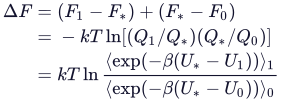
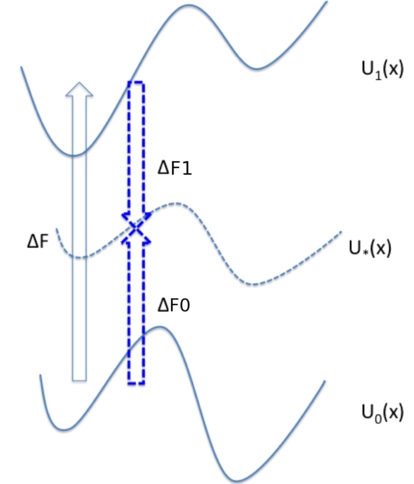
Bennett figured out the optimal potential for the imaginary intermediate state which minimizes the variance of the calculated free energy. The Bennett acceptance ratio method works by solving the following two equations through iteration:


where N0 and N1 are the number of data points sampled from U0 and U1,

is the Fermi function, and

The free energy difference between a pair of ligands that are directly connected in the FEP perturbation graph is estimated using the above BAR method.
The BAR method also provides estimates of the statistical uncertainty in the calculated free energy. These error estimates reflect how precisely the free energy can be determined from a finite amount of simulation data: with longer simulations (more data points), the errors decrease. Two independent estimates of the uncertainty are computed for each simulation leg (complex and solvent) of each perturbation: an analytical error and a bootstrap error.
The analytical error is derived from the variance of the BAR estimator, which Bennett showed can be calculated directly from the Fermi function evaluations used in the BAR calculation [11]:

where the notation is the same as in the BAR equations above. Each term captures the variance contribution from one ensemble: how well the Fermi function values are determined from the N0 or N1 samples. The square root of this variance gives the analytical error.
The bootstrap error provides an alternative uncertainty estimate through resampling. For each simulation leg, N0 data points are randomly drawn with replacement from the original samples of the first state, and N1 data points from the second state. The BAR free energy is recalculated from this resampled data. This process is repeated many times, and the standard deviation of the resulting free energy values gives the bootstrap error.
For each simulation leg, the Bennett error is the larger of the analytical and bootstrap errors. The Bennett error for the full perturbation combines the complex and solvent leg errors as the root sum of squares. In almost all cases, the Bennett error underestimates the true error in the calculated free energy, because it only measures statistical sampling noise: how much the calculated free energy would vary if the same simulation were repeated with different random seeds. The Bennett error does not detect systematic problems such as insufficient phase space overlap between the two end states, conformational trapping, or other convergence failures.
The cycle closure method, described in FEP Cycle Closure Method and Error Estimates, addresses this limitation by exploiting the topology of the FEP perturbation graph. Because free energy is a thermodynamic state function, the free energy changes around any closed cycle must sum to zero. Deviations from zero (hysteresis) indicate that one or more edges in the cycle have errors beyond what the Bennett error captures. The cycle closure method uses these deviations to produce adjusted free energy estimates and more realistic error bounds for each edge.