Conversion of ΔΔG Values to ΔG Values
The relative binding affinity of all the other ligands to the reference ligand (which is usually the hub of the graph) is called the relative dG.
To convert the relative binding free energies to absolute binding free energies, we need to know the absolute binding free energy for at least one of the molecules. In retrospective studies, in principle, we can choose any molecule as the reference compound, and force the predicted ΔG value of the reference compound to be equal to the experimental value ΔGexp. However, if the experimental measurement for the reference compound has a large error, the error will propagate to the estimated binding free energies for all the other molecules using this method. So to minimize the error introduced in choosing an arbitrary compound as the reference compound, we instead choose all the compounds with experimental binding free energies available as the reference. To be specific, if there are N molecules with experimental binding free energies available, we use the following equation to calculate an offset ẟ to convert the relative binding free energies to absolute free energies:

This can be rewritten as:

The predicted binding free energy for any ligand i is then calculated with the following equation, where ΔΔGpredji is the predicted relative binding free energy energy of ligand j with respect to ligand i, after cycle closure correction:

In retrospective studies, all the molecules are used as references to convert relative binding free energies into absolute binding free energies. In prospective studies, if multiple molecules are available with experimental binding free energy data, all of them are used as references to calculate the absolute binding free energy for the new molecules.
Although the relative binding affinity is independent of the path used to do the calculation (due to the application of the cycle closure correction), the error usually is different along different paths. The error along each path is calculated as:

where εi is the error along path i, εμ i is the cycle closure estimated error for edge μ along path i, and the summation is over all edges μ along path i from the reference ligand to ligand A. If there are multiple paths i from the reference ligand to ligand A, the error of the predicted relative dG is reported as the minimum of the errors along all the paths, ie:
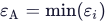
The error calculated in this way is called the error of dG prediction.