Dealiasing Function File Format and Description
The first line of a dealiasing function file contains a character string which includes the version number of Jaguar. This string should be “dafv” followed immediately by four digits giving the version number times 100. Lead zeros are added if necessary.
The second line has two integers. The first integer gives the number of dealiasing function sets provided for each atom type; each set is used for a particular grid during the calculation. The ordering of the sets used for each grid type is determined by the parameters named dcoarse, dmedium, and so on, which are specified in the gen section of the input file. By default, the coarse grid is listed first, then the medium, fine, ultrafine, and gradient grids, in that order.
The second number in the second line gives the number of ranges described in each of these dealiasing function sets. The ranges correspond to particular RwR blocks for the calculation. One of these ranges is the long range, basically covering the whole molecule; another is the home atom range, which actually only includes the relevant atom itself; and the rest are increasingly large neighbor ranges. The number of ranges should currently not exceed 10. The sample file’s second line indicates that for each basis set, five dealiasing function sets are specified for each atom, and that each of these sets contains dealiasing functions for a total of six ranges: the long-range functions, the functions for the home atom, and the functions for four other neighbor ranges.
The distances defining the neighbor ranges are set in the next line of real values, in units of bohr. Note, however, that generally only the third neighbor range is actually used. The first distance specifies that if the basis function whose coefficient is being evaluated is to be approximated by short-range dealiasing functions, then the dealiasing functions for first-order neighbors will be used for each atom within this distance of the atom upon which the basis function is centered (except for the basis function atom itself, for which the home atom dealiasing functions will be used). The second distance defines which atoms are considered second-order neighbors to each other, and so on. Since the number of neighbor ranges includes not only these ranges but also the long range over the entire molecule and the home atom range consisting of the relevant atom itself, the number of neighbor ranges actually specified in this line of the .daf file should be two less than the number of ranges listed in the previous line. Thus, in the sample file, the distances listed specify the neighbor ranges for first- through fourth-order neighbors.
The rest of the .daf file contains the dealiasing function sets for each atom type within each basis set. The data for each basis set should begin with a line listing the basis set name (as listed in Basis Sets), including the “*” characters indicating the polarization functions (e.g., 6‑31G**). The first line for each atom type for that basis set should list three integers: the atomic number for that atom type, the number of uncontracted dealiasing functions about to be listed for each neighbor range in each set, and the corresponding number of contracted dealiasing functions. In the sample file, the first atom whose dealiasing functions are listed is hydrogen, since the atomic number listed is 1. The same line says that ten uncontracted functions and two contracted functions will be specified for each range in the five sets of dealiasing functions for hydrogen.
The second line for the same atom type should list real dealiasing exponents for each uncontracted function. The exponents specify what functions can be used. For instance, in the sample file, hydrogen’s s-type uncontracted basis function from the first exponent would be  , while the p-type uncontracted basis function for the same exponent would be
 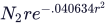 . N1 and N2 are normalization constants.
Below those two lines, the dealiasing function sets for that atom type should be listed set by set. By default, the first set will be used for the coarse grid, the second for the medium grid, and so on, with the last set corresponding to the gradient. This ordering can be changed in the gen section of the input file. Each set should contain a line for each neighbor range; the long-range functions should be specified first, then the home atom functions, then the functions for each neighbor range, in increasing order. Within each line, there should be several integers, one for each uncontracted function, then one for each contracted function. These integers dictate how to construct the actual functions from the exponents (just given in the .daf file for uncontracted functions, and already established in the .basis file for contracted functions) and contraction coefficients for contracted functions (also established in the .basis file). If the value is 1, an s-type function will be constructed using the relevant exponent or exponents; if 2, a p-type function; if 4, a d-type function; if 8, an f-type function; and if 16, a g-type function. To construct more than one of these types of functions with the same exponent or exponents, the relevant numbers should be added together (for instance, 1 + 2 + 4 = 7 for s, p, and d).
The exponent or exponents for each of these functions are determined by the position of the entry in the row. The uncontracted functions are described first, in the same order as their exponents were listed earlier, and the contracted functions corresponding to the contracted functions found in the .basis file are described next, in the same order as in the basis set file. Uncontracted functions in the basis set file should be ignored. Finally, the first derivatives of the basis set file contracted functions will be calculated, and the values listed for these “extra” functions correspond to the functions generated this way, in order of the function they were generated from and, within that order, of increasing complexity (s before p, etc.). For instance, if the basis set contained contracted functions for 1s, 2s, and 2p orbitals, the derivatives would be listed in the following order: a p-type function resulting from the derivative of the 1s function, a p-type function resulting from the derivative of the 2s function, an s-type function resulting from the first term of the derivative of the 2p function, and a d-type function resulting from the second term of the derivative of the 2p function.
The last six lines of the sample .daf file correspond to the gradient dealiasing function set for He (note that the atomic number specified for those five dealiasing function sets was 2). The first line of this set describes this set’s long-range dealiasing functions centered on the He atom, which will be used when coefficients for long-range basis functions are to be calculated, as explained above. The second value on this line, 3, dictates that uncontracted s-type and p-type (1 + 2 = 3) basis functions are to be constructed using the second exponent provided for this atom (0.145957). The second line of the set, which describes this set’s He-centered dealiasing functions to be used when calculating the coefficients for He-centered short-range basis functions (the home atom line of the set), has a value of 1 entered in the eleventh column, meaning that an s-type contracted function will be calculated using the exponents provided for the first contracted function for He in the basis set. Since this basis set only provides one contracted function for He, the 1s function, whose derivative is a p-type function, the last number entered on that line (2) dictates that a p-type function be constructed, using the contraction coefficients and exponents that correspond to that derivative function, as explained in the previous paragraph.