Jaguar Surfaces
Surfaces provide 3D spatial information about a molecule that cannot be obtained by merely calculating property values. Jaguar can generate electrostatic potential, average local ionization energy, noncovalent interaction, electron density, electron density difference, electron spin density, Fukui function, and orbital surface data, which can be visualized in Maestro. When you generate the electrostatic potential, the values at the nuclei are also added to the Maestro file as an atom property. Values at ECP centers should be ignored as erroneous, due to the missing core contributions.
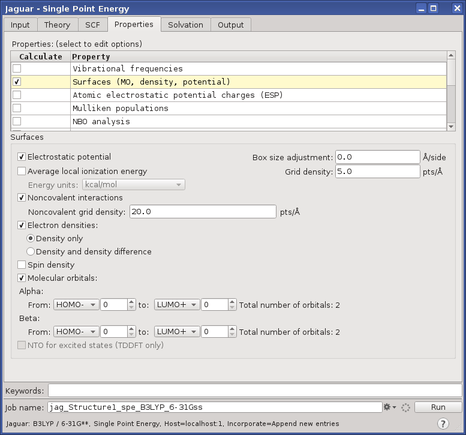
Surfaces such as the electrostatic potential (ESP) and average local ionization energy (ALIE) are helpful for determining charge buildup and reactivity at various locations in a molecule. The ESP describes the potential energy experience by a positive test charge at a point in space; the ALIE is a sum of orbital energies weighted by the orbital densities [115,117], which provides an energetic measure of how easy or difficult it is to remove electrons from regions of the molecule. The ALIE is better than the ESP at describing how a molecule would respond to electrophilic attack. In addition to the surfaces, an analysis of the ALIE and ESP on an isodensity surface is performed, recorded as a set of atomic and molecular properties in the output file and the Maestro file.
Noncovalent interactions (NCI) can be visualized with the help of the reduced density gradient and interaction strength, following the methods of Johnson et al [271]. NCI plots take the form of surface maps, somewhat like color-coded ESP maps. The isosurfaces show where there are interactions between noncovalently-bound atoms, and the map coloring indicates the strength and favorability or unfavorability of the interactions. Note that the “interaction strength” is not in terms of energy, but in terms of electron density. However, there is some correlation between the magnitude of the interaction strength and the intermolecular binding energy. Since the electron density is on an absolute scale, it is possible to compare the NCI maps of different molecular systems. The method is only valid for molecules at equilibrium (or near-equilibrium) geometry, so it is advisable to perform a geometry optimization first. For dispersively-bound systems, it is not necessary to use explicitly correlated theoretical models like LMP2. This is because the NCI surface plots are based on the electron density, not the total energy. Density difference plots for correlated and uncorrelated levels of theory typically show small differences, while the differences in total energies, or intermolecular binding energies, can be large.
In addition to the reduced density gradient and interaction strength, the Laplacian of the density is calculated. The Laplacian surface can be used to identify places of electron excess and deficiency, and in turn, sites of reactivity. Holes in the isosurface identify potential sites for nucleophilic attack, as well as the preferred angle of attack.
The electron density difference surface is the difference between the initial guess density and the density from the final converged SCF wave function. The interpretation of this density difference therefore depends on the initial guess. For example, if the initial guess density is the superposition of atomic densities, then the difference density is the density change on molecule formation. If it is derived from another geometry, it represents the relaxation of the density due to the geometry change.