Thermochemical Properties from Jaguar Calculations
- Overview
- Additional Resources
Thermochemical calculations of the constant volume heat capacity (Cv), internal energy (U), entropy (S), enthalpy (H), and Gibbs free energy (G) at a specified temperature and pressure are performed by default whenever vibrational frequencies are calculated1. You can also calculate thermochemical properties as a function of temperature. Rotational symmetry numbers, which identify the number of orientations of a molecule obtained by rotation that are superimposable, and zero point energies are also computed. You can calculate these properties only if you are also computing vibrational frequencies.
Thermochemical properties can be plotted in the Thermochemistry Viewer Panel as a function of temperature and pressure ranges.
A vibrational frequency calculation gives the following thermochemical quantities, which can be viewed in the Property Table or a Jaguar output file:
| Property | Variable | Units | Equation | ||||
| Zero Point Energy | ZPE | kcal mol-1 |

|
||||
| Internal Energy | U | kcal mol-1 |
|
||||
| Heat Capacity | Cv | cal mol-1 K-1 |

|
||||
| Entropy | S | cal mol-1 K-1 |
|
||||
| Enthalpy | H | kcal mol-1 |

|
||||
| Free Energy (Gibbs Free Energy) | G | kcal mol-1 |

|
||||
| Total Internal Energy | Utot | hartree (atomic unit) |

|
||||
| Total Enthalpy | Htot | hartree (atomic unit) |
|
||||
| Total Free Energy (Total Gibbs Free Energy) | Gtot | hartree (atomic unit) |
|



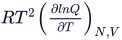
In the above table, νi is the harmonic frequency listed in the output in cm-1. Pressure (P) and Temperature (T) are user inputs set in the Properties Tab. R is the gas constant, lnQ is the natural log of partition function Q, and ESCF is the SCF Energy.
U, H, and G are thermal contributions to the internal energy, enthalpy, and Gibbs free energy, computed from the partition function. These values do not include the zero point energy (ZPE) or the SCF energy (ESCF). Utot, Htot, and Gtot are the corresponding total quantities that include ESCF and ZPE as shown in the table. Jaguar assumes the ideal gas approximation (PV = RT for one mole) and evaluates the enthalpy as H = U + RT.
Q is obtained from the vibrational frequency calculation using the harmonic approximation. In practice, the translational, rotational, vibrational, and electronic components of Q are calculated separately. The translational component of Q depends on pressure and temperature, which are user defined. The rotational component of Q depends on the user-defined temperature and the rotational temperatures, which are printed in the output. The vibrational component of Q depends on the user-defined temperature and the vibrational temperatures, which are printed in the output. The electronic component of the partition function is assumed to be the spin multiplicity of the molecule. The equations for the components of Q are used in the equations for U, CV, and S listed in the table above to obtain the corresponding translational, rotational, vibrational, and electronic components of these values.
For more information on thermodynamic quantities and how they are calculated in practice, see https://cccbdb.nist.gov/thermox.asp and Essential Statistical Thermodynamics.