Desmond performance data for supported cards
Choosing the right hardware is crucial for maximizing the efficiency and throughput of your Desmond Molecular Dynamics (MD) simulations. This page provides Desmond performance benchmarks for Schrödinger supported NVIDIA GPUs to help you select the optimal hardware for your specific performance needs and budget constraints.
All benchmarks were run using standard Desmond input files for two common biological systems:
-
DHFR (Small System): Dihydrofolate reductase in a water box (~24,000 atoms). This represents a standard protein simulation.
-
FACTOR IX (Large System): The zymogen Factor IX in a water box (~93,000 atoms). This represents a larger, more computationally demanding system.
1. Raw Simulation Performance
The first benchmark measures raw simulation performance, defined as the number of nanoseconds (ns) of simulation that can be completed in a 24-hour period, denoted as ns/day. In this context, a nanosecond represents "simulated time", meaning that a rating of 100 ns/day indicates the GPU is capable of simulating 100 nanoseconds of molecular movement in one real-world day. When reading the associated performance charts, it is important to remember that higher values represent better performance and faster simulation speeds.
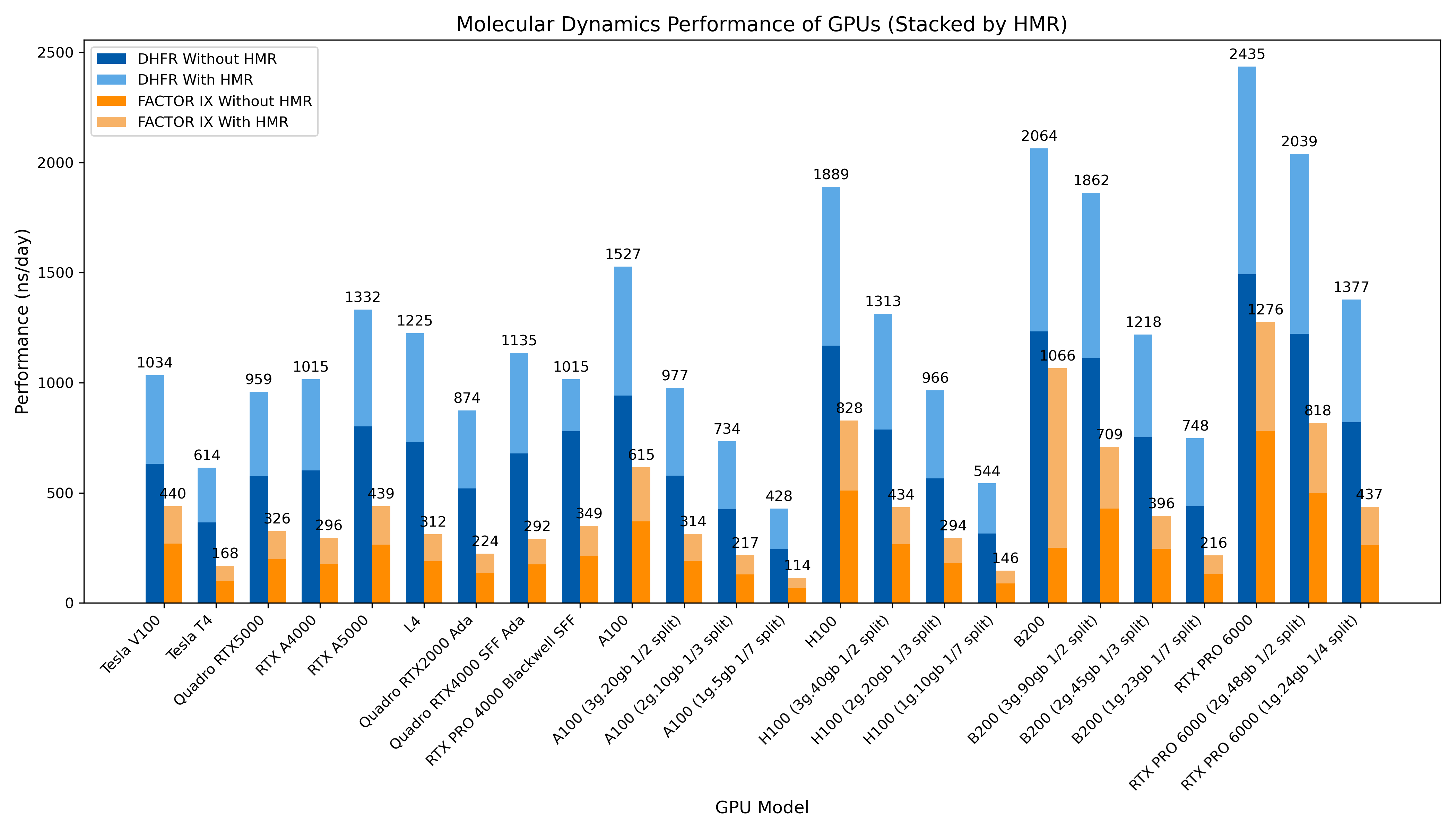
Figure 1: Raw performance of various NVIDIA GPUs on the DHFR (dark blue is without HMR, light blue is with HMR - see note below) and FACTOR IX (orange) systems measured in ns/day. Higher values indicate better performance.
Benchmarks were run with release version 2026-3.
(Please note that published Desmond / FEP+ performance benchmarks were conducted using a specific GPU edition and that actual performance may vary depending on the hardware variant).
2. License-Normalized Performance
While raw speed is important, Desmond simulations also require license tokens to run. MD simulations run on different GPUs consume a different number of Desmond license tokens (see the License Usage per GPU Calculator), which impacts the total cost of running simulations.
The license-normalized benchmark provides a measure of performance efficiency by adjusting the raw performance based on the number of license tokens required by each GPU, offering a "performance-per-token" (ns/day/license) value.
When reviewing these efficiency metrics, higher values indicate better performance efficiency. For example, you may find that running several MD simulations on MIG-partitioned H100 GPU instances allows you to complete more MD calculations in parallel across your team than running them on the non-partitioned H100 card because the MIG partitions provide more simulation time for every license token spent.
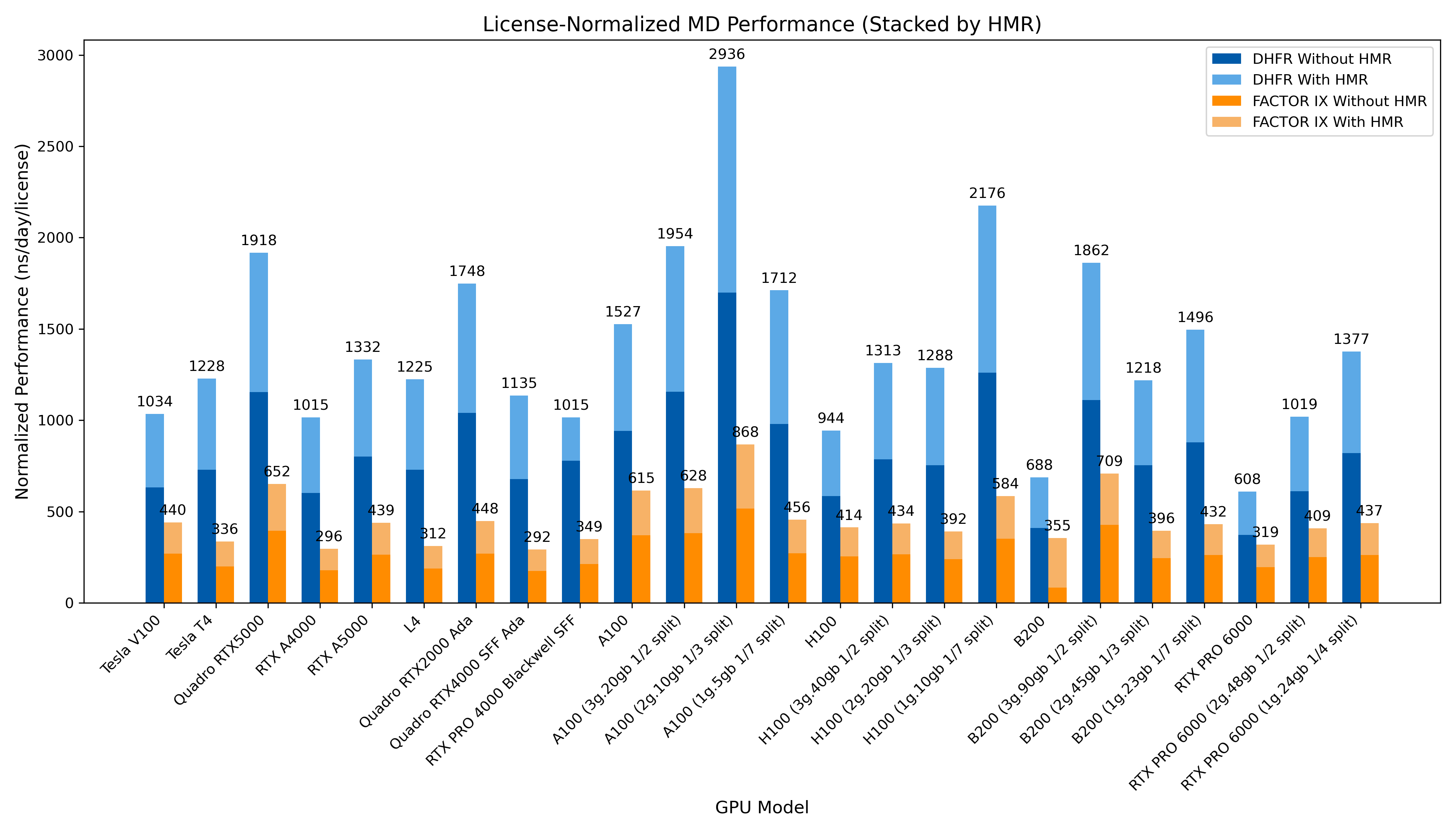
Figure 2: License-normalized performance of various NVIDIA GPUs on the DHFR (dark blue is without HMR, light blue is with HMR - see note below) and FACTOR IX (orange) systems measured in ns/day/license. This metric shows the simulation speed weighted by the number of Desmond license tokens used. Higher values indicate better performance efficiency.
Benchmarks were run with release version 2026-3.
(Please note that published Desmond / FEP+ performance benchmarks were conducted using a specific GPU edition and that actual performance may vary depending on the hardware variant).