The Job Life Cycle on a local machine (single node)
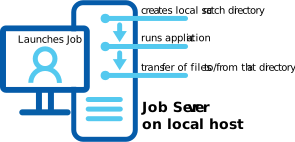
The Job Server infrastructure enables you, a user of the Schrödinger Suite, to submit scientific computations (jobs) to your local machine and manages the running of those jobs. A local job submission refers to jobs submitted both from and to one computer, which can be a physical machine or a virtual machine. In this case, the computer will take on all three roles: Submission Host, Server Host, and Execution Host. A local Job Server is automatically configured and will manage the running of Schrödinger Suite jobs.
It is useful to understand how Schrödinger Suite jobs are run in order to contextualize how to utilize Job Server.
The "life cycle" of a job can be summarized as follows:
-
Jobs are submitted - either from Maestro or on the command line - from the user on the computer where the Schrödinger Suite software is installed. The local Job Server starts automatically.
-
The Submission Host sends the jobs to the Server Host. The Server Host is where the Job Server process (jobserverd) runs, and it is what manages the job submission from both Maestro and the command line and transfer of the input and output files of a job. If a job is run locally, the job is sent from the Submission Host to a "local Job Server". If a job is run remotely, the job is sent from the Submission Host to a Job Server on a remote cluster.
-
The Server Host sends the jobs to the Execution Host(s), where the jobs are performed.
-
After a job is completed, the Server Host manages the transfer of job output between the Execution Host(s) and the Submission Host.
|
|