Surfactant Tilt Viewer Panel
Show time series and histogram plots of tilt and rotational angles of surfactants.
To open this panel: click the Tasks button and browse to Materials → Classical Mechanics → Trajectory Analysis → Surfactant Tilt Results.
To open this panel from the entry group for the results of a surfactant tilt job .
.
The following licenses are required to use this panel: MS Maestro
- Features
- Additional Resources
Surfactant Tilt Viewer Panel Features
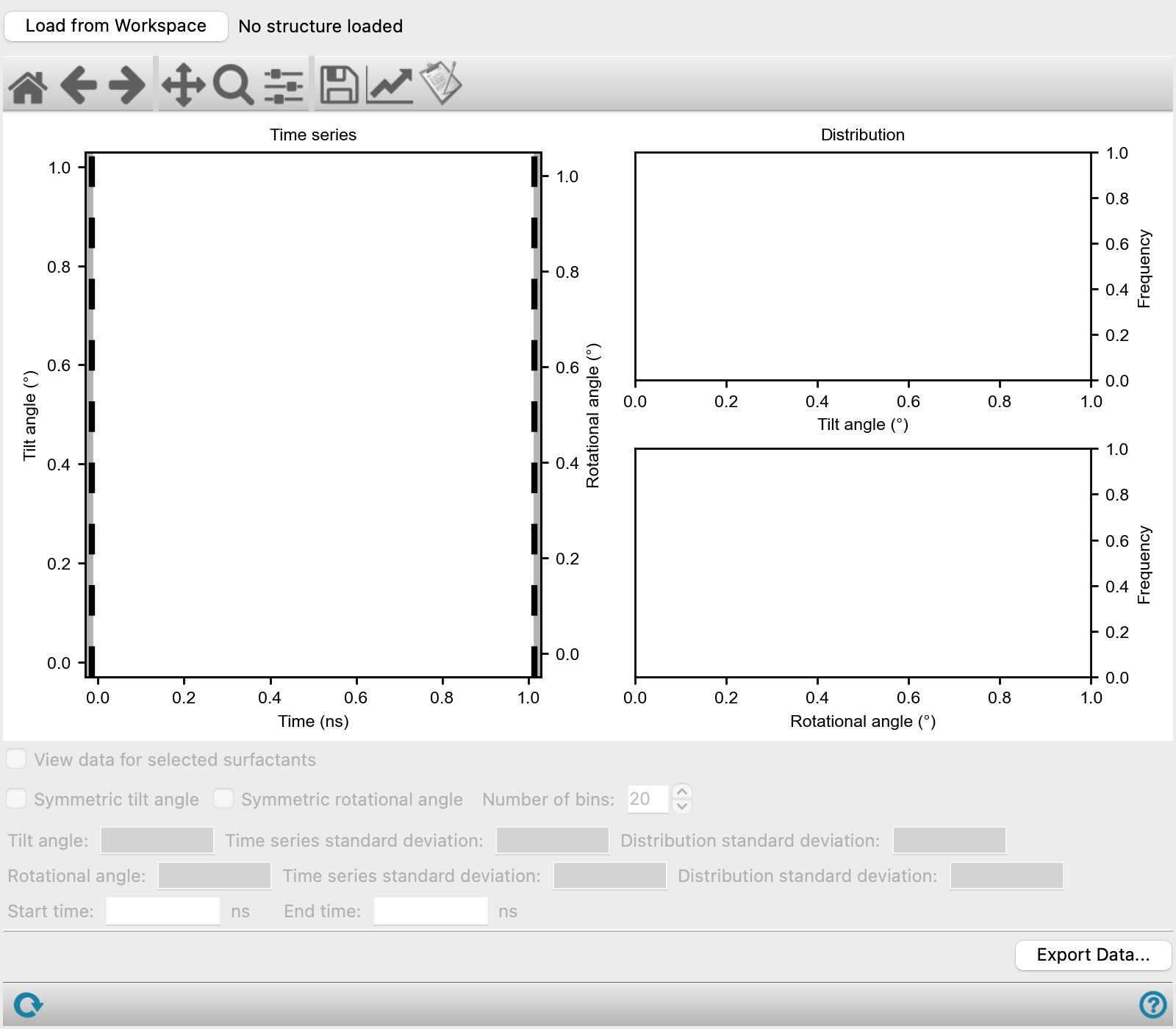
- Load Data from Workspace button
-
Read the surfactant tilt and rotational angles for the structure in the Workspace.
- Plot toolbar
-
The toolbar has tools for manipulating the plot and for saving images. The buttons that are common to all plot toolbars are described in the Plot Toolbar topic.
- Time series plot
-
The time series plot shows the mean tilt and rotational angles for each time step as a function of simulation time. There are two vertical slider bars, one on each side of the plot, which can be used to set the start and end time used for the calculation of the tilt and rotational angles. When you drag the sliders, the time in the Start time and End time text boxes is updated to reflect the slider position. The tilt and rotational angles are calculated over the restricted time range, and the histogram plots and property text boxes are updated to show the distribution of tilt and rotational angles in the restricted time range.
- Distribution plots
-
These plots show histograms of the mean tilt and rotational angles in the restricted time range from the time series plot. The mean tilt and rotational angles over all molecules and time steps (as plotted in the time series plot) are divided into N bins. You can modify the number of bins in the Number of bins text box. The plot is updated as you adjust the start and end time.
- View data for selected surfactants option
-
Show mean tilt and rotational angles only for surfactant species that have atoms selected in the Workspace. The time series and histogram plots are updated.
- Symmetric tilt angle option
-
Treat surfactants with the same tilt angles but opposite directions (above or below the surface plane) as symmetric.
- Symmetric rotational angle option
-
Treat surfactants with the same rotational angles but opposite directions (above or below the surface plane) as symmetric.
- Number of bins text box
-
Adjust the number of bins for the histograms plots.
- Property text boxes
- These non-editable text boxes report the values of the following properties:
-
- Tilt angle—mean tilt angle for all molecules and time steps
- Time series standard deviation—calculated from the tilt angles in the Time series plot
- Molecule distribution standard deviation—calculated from the tilt angles in the Molecule distribution histogram plot
- Rotational angle—mean rotational angle for all molecules and time steps
- Time series standard deviation—calculated from the rotational angles in the Time series plot
- Molecule distribution standard deviation—calculated from the rotational angles in the Molecule distribution histogram plot
- Start time and End time text boxes
-
Specify the simulation start time and end time to limit the range of times over which the persistence length is evaluated. These text boxes are linked to the slider bars in the Time series plot.
- Export Data button
-
Export time series data, tilt angle histogram, and rotational angle histogram data to CSV files. Opens a file selector for each set of data.
- Status bar
-
 to reset the panel to its default settings and clear any data from the panel.
If you can submit a job from the panel, the status bar displays information about the current job settings and status for the panel. The settings include the job name, task name and task settings (if any), number of subjobs (if any) and the host name and job incorporation setting. The job status can include messages about job start, job completion and incorporation.
The status bar also contains the Help button
 , which opens an option menu with choices to open the help topic for the panel (Documentation), launch Maestro Assistant, or if available, choose from an option menu of Tutorials. If the panel is used by one or more tutorials, hover over the Tutorials option to display a list of tutorials. Choosing a tutorial opens the tutorial topic.