SiteMap Calibration
SiteMap Calibration
To calibrate and characterize the SiteMap properties, SiteMap has been applied to an extensive set of 230 proteins, which were taken either from the Glide database-enrichment suite or from the PDBbind database [6]. These proteins bind ligands of molecular weight at least 150 with affinities of at least 100 μ M. Of the 230 proteins, 155 have binding affinities of 1 μ M or less. The proteins were prepared using standard Schrödinger techniques. To avoid prejudicing the search, all crystallographic water was removed.
The entire data set was used to optimize the contributions to the overall SiteScore of the SiteMap properties described in How SiteMap Evaluates Sites. The criterion for the optimization was that the site with the best SiteScore corresponded to the co-crystallized site as often as possible. The tight-binding set was further used to calibrate SiteScore and its contact, phobic, and philic components so that the average value for each of these quantities is 1.0. The most significant terms are the size of the site as measured by the number of site points, the relative openness of the site as measured by the exposure and enclosure properties, and the tightness of the site as measured by the contact property. The phobicity of the site plays a smaller role, and the site philicity plays a small enough role that it could have been excluded.
Table 1 summarizes SiteMap’s accuracy in locating the primary (co-crystallized) binding site for the 230 proteins and for the 155 submicromolar binders. As Nayal and Honig [1] find for Screen and report for other methods, size is a fairly good predictor of the ligand-binding site. However, SiteScore is a better predictor, correctly locating the primary binding site in 96.5% of the proteins in the full set and 98.1% in the tight-binding set.
SiteMap can also be employed as a “classifier” to discriminate sites that bind ligands from sites that don’t. The objective is to determine whether a protein is likely to bind ligands tightly, not to decide which site in the protein to target. SiteMap can be used in this way by setting a threshold SiteScore value for recognition as a drug-binding site of 0.80 (80% of the average found for the 155 submicromolar sites). Used as a classifier, SiteMap performs as shown in Table 2. Similar results for the percentage of primary binding sites correctly classified (true positives) were reported for a different set of proteins by Nayal and Honig [1].
For a more recent and more extensive set of tests, see Ref. 8.
SiteMap Benchmark
The PDBbind v2020 dataset was used to benchmark SiteMap. From the SiteMap results of the site detection mode run, a site is determined to be liganded if the site center is within 4 Å of any ligand atoms. The performance of SiteMap on site detection was evaluated by checking whether the top 5 returned sites contain at least one liganded site based on the DCC criterion. As shown in Table 3, SiteMap identified the liganded site in over 85% of PDBs with small molecule ligands, and performance decreased as ligand size increased. This is expected, as the default SiteMap configurations are tuned towards identifying well-defined small molecule ligand binding sites and may not effectively capture protein-peptide or protein-protein interfaces.
SiteMap was also run with the Detect shallow binding sites option to evaluate performance on detecting peptide and protein ligand binding sites. As shown in Table 4, the shallow mode improved the detection of peptide and protein binding sites.
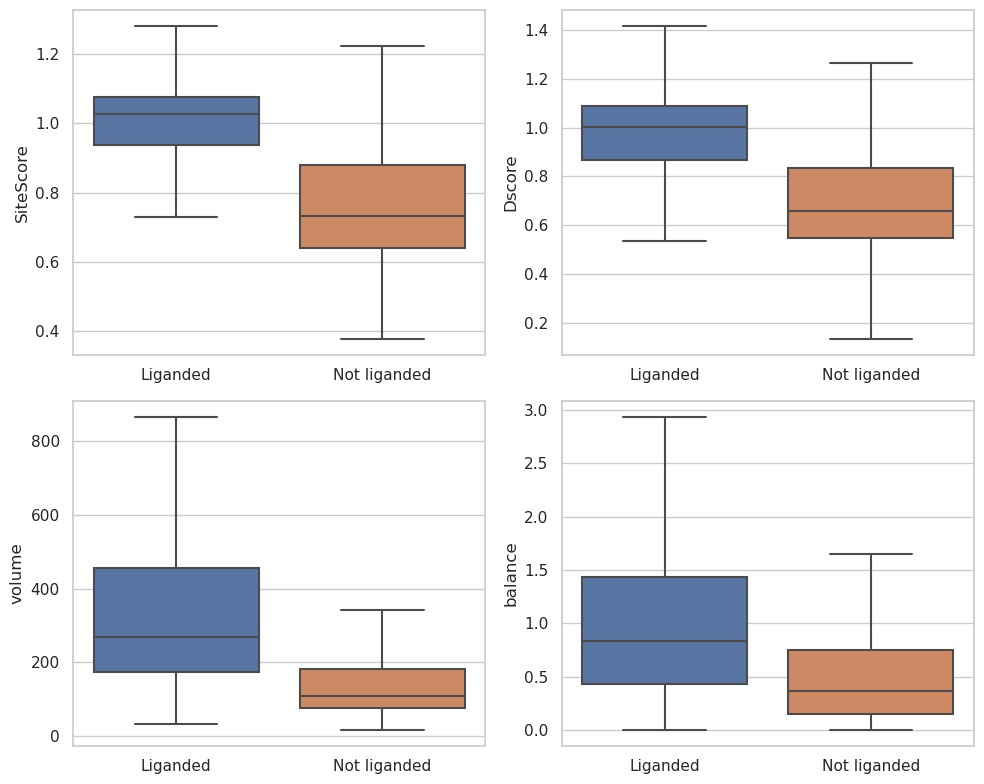
The SiteMap metrics of liganded and non-liganded sites were compared for PDBs with small molecule ligands. As shown in Fig. 1, liganded sites have significantly higher SiteScore and Dscore than non-liganded sites. SiteScore is therefore a good indicator for distinguishing ligand binding sites from other sites. The median SiteScore of liganded sites is 1.03, so a SiteScore of 1.0 should be a good cutoff for prospective use.
Fig. 1. SiteMap output metric distributions of liganded sites and non-liganded sites
As the PDBbind dataset contains curated binding affinity data for each structure, the relationship between SiteScores and ligand binding affinities was further examined. To ensure the SiteScore represents the ligand binding site property, the analysis focused on sites with greater than 0.5 site-ligand overlap. Average ligand binding affinities increase as SiteScores increase, indicating that a site with a higher SiteScore is more likely to bind a ligand with good binding affinity.